Why Time Zone Alignment Is Crucial When Hiring Remote Developers
Hiring remote developers gives companies access to global talent but your choice of time zone dictates your team's communication overlap and project delivery timeline. This guide covers what time zone misalignment actually costs, how to assess time zone fit before hiring and how to manage distributed teams to guarantee timely project delivery.

“Furqan Aziz is CEO & Founder of InvoZone. He is a tech enthusiast by heart with 10+ years ...” See more
Don’t Have Time To Read Now? Download It For Later.
Table of Contents
When you hire a remote developer, a strict time zone match seems like a minor detail.
It is not.
This assumption ignores the hidden tax of asynchronous lag. Software development is highly collaborative and deeply iterative. When your core team logs on just as your remote engineer is logging off, a single question about an unclear requirement or a minor API bug instantly turns into a 24-hour delay.
The wrong hiring choice can create endless rework, increase management time and hinder your timely delivery.
The real question is: do their working hours actually fit your business workflow?
Let’s look at exactly what this time zone gap costs your bottom line and how you can ensure timezone alignment before hiring your next remote developer.
What Happens When Time Zones Do Not Align?
Most companies discover time zone problems after hiring.
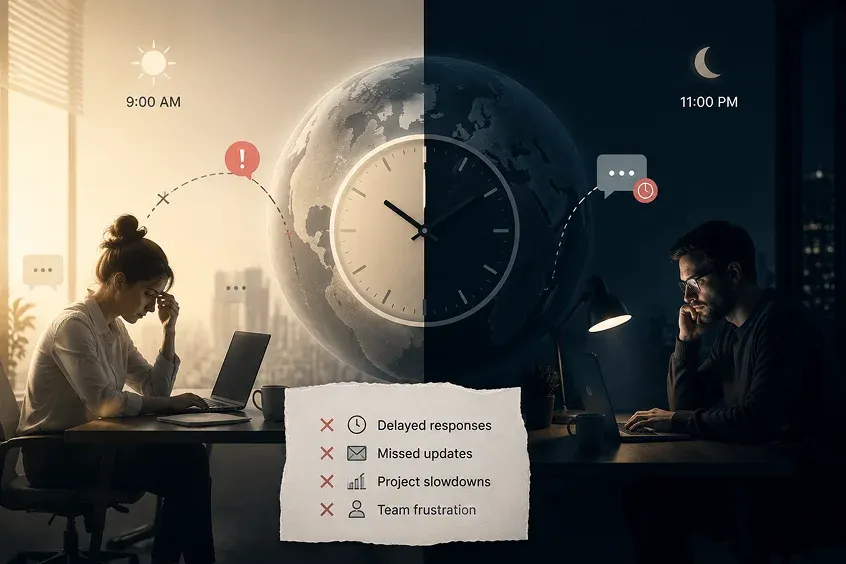
Harvard Business School research found that even a single hour of time zone difference reduces real-time collaboration by 11% and cuts regular workday communication opportunities by 19%. Multiply that across an eight to twelve hour gap, and the effect on sprint velocity is so significant.
Here is what misaligned time zones typically produce in a remote development setup:
Delayed feedback
Developers wait too long for answers on requirements, designs, bugs and approvals.
Slow code reviews
Pull requests sit pending because reviewers and developers are not online at the same time.
Longer QA cycles
A bug found during testing cannot be verified, explained and fixed on the same day when QA and development are working opposite shifts.
Deployment delays
Release issues take time to fix when developers, DevOps and QA teams are available at different hours.
More after-hours pressure
Remote developers often have to stretch their normal schedules to attend late-night status calls or answer urgent messages.
Higher burnout risk
Developers who are expected to stay available outside normal working hours can lose focus, consistency, and motivation. Over time, waking up early or staying up past midnight to stay in sync with the main office ruins their work-life balance.
Weak team connection
Developers who rarely overlap with the core team end up missing out on product contexts, business priorities and important decisions.
The Real Cost of Ignoring Time Zone Fit
More than 57% of project failures trace back to communication gaps rather than technical shortfalls.
Time zone misalignment is one of the most consistent drivers of those gaps.
Saving $15 or $20 an hour on a developer’s rate means absolutely nothing if your project misses its market launch date by three months. Paying a slightly higher rate for a well-aligned offshore developer gives you the guarantee of continuous and same-day progress.
When Real-Time Overlap Is Non-Negotiable
Some development work moves smoothly through asynchronous communication. Some work can be done asynchronously. Developers can leave written updates, comment on tickets, record Loom videos, or document decisions.
But not every development task works well that way.
Real-time overlap is important when the work is complex, unclear, urgent, or dependent on multiple people.
Real-time availability matters most when:
- A bug requires immediate clarification before the developer can continue
- A release is blocked and needs a fast decision from the client or product lead
- A developer needs architectural guidance before proceeding with a feature
- QA finds a critical issue in the hours before a scheduled deployment
- A client changes requirements mid-sprin
- A pull request needs live discussion before it can be merged
- A new developer is onboarding and needs fast answers to get to first commit
For routine tasks, async communication can work well. However, for complex software development, some live overlap is still necessary.
How to Assess Time Zone Fit Before Hiring
Time zone compatibility should be evaluated during the hiring process, not after the contract is signed.
Before committing to a remote developer, ask these questions directly:
- What hours will this developer work, and in which time zone?
- How many hours per day will overlap with your core team?
- Can they attend sprint planning, daily standups, and demo calls without adjusting outside normal working hours?
- When will code reviews happen relative to your team's schedule?
- Who handles blockers that arise during their workday?
- What is the expected response time for urgent issues?
- How are production incidents handled if they occur outside the developer's working hours?
If the answers are vague or dependent on the developer regularly working late, the arrangement will create friction as the project progresses.
Agencies like InvoZone give direct access to 1,000+ pre-vetted remote developers, each screened for communication habits and time zone compatibility before any client introduction. That eliminates the guesswork in the hiring phase and removes the most common source of post-hire delays.
How to Manage Time Zone Differences Once the Developer Is Onboarded
Even with well-aligned developers, time zone management requires a deliberate structure. Without it, working-hour overlap alone does not prevent communication gaps from forming.
Define core overlap hours
Agree on a fixed window when every team member is available for live collaboration. This is when discussions on standups, sprint planning, and urgent decisions take place. Follow these hours.
Separate urgent from non-urgent communication
Not every message needs an instant reply. Define what qualifies as urgent and what can wait for the next overlap window. Teams that treat every message as urgent create constant interruptions that fragment deep work.
Use asynchronous updates with structure
Developers should document their progress regularly. Structured async communication keeps the team aligned without requiring everyone to be online at the same time. Developers should share what they worked on, what is blocked, what needs review, and what is next.
Document decisions as they happen
Every product decision, technical direction change, sprint outcome, and architectural choice should be recorded in a shared location. If developers miss a live discussion, documentation keeps them aligned with the rest of the team.
Respect working hours
Avoid late-night messages, random calls, or urgent requests outside agreed hours. Consistent after-hours communication can increase burnout risk, especially for developers with responsibilities outside work.
Use proper tools
Use Slack or Teams for communication, Zoom or Google Meet for calls, Jira or Linear for task tracking, GitHub or GitLab for code, and Notion or Confluence for documentation. The goal is one clear location for each type of information.
💡 Expert Advice: The 3-Item Status Rule
To keep your engineer or dedicated development team perfectly aligned without wasting hours on Zoom, require every developer to post a bulleted message at the end of their workday covering exactly three things:
- Completed: What did they just finish?
- Blockers: What is stopping them from moving forward right now?
- Next Steps: What exactly will they work on when they log back in?
The Big Perks of Staying in Sync
When you match working hours, your development engine runs a lot smoother. Here is what you gain:
Faster answers
Developers can ask questions and clear up tricky coding requirements instantly. Instead of waiting 24 hours for a reply, a critical bug can be discussed and fixed in a quick 5-minute chat.
A highly connected team
Live daily syncs, team chats and planning sessions are easy to schedule. Working together in real-time builds a lot more trust and a stronger team connection.
Less burnout and stress
When developers work regular local daytime hours, they don't have to stay up for meetings. This keeps them happy and more focused on your project.
Predictable daily hand-off
Having a clear shared window makes passing work back and forth incredibly smooth. Your code updates therefore keep moving forward steadily.
How InvoZone Solves the Time Zone Problem
InvoZone helps companies avoid the common time zone problems that slow down remote development. Here is what we guarantee.
100% time zone-aligned collaboration
InvoZone matches companies with developers who work your business hours, whether your team operates on EST, PST, or any other schedule. Developers log on exactly when you need them.
Zero-lag feedback loops
With time zone-matched developers, code reviews, approvals, and blockers are addressed within the same working day. There are no delays.
Onboarding within 24-hours
Top 3% developers are integrated into your workflow within 24 hours of engagement. Pre-vetted for technical skill, communication, and project fit, they contribute from day one without the ramp-up delays common in standard remote hiring.
AI-enabled developers
The dedicated AI developers are familiar with modern AI-assisted development tools including GitHub Copilot, Cursor, Claude Code, and ChatGPT. They integrate into contemporary engineering workflows without requiring additional training and work 22% more efficiently.

Crucial Next Step: Building Trust Beyond the Clock
Matching work hours is just the first step. When you build deep trust and help remote workers feel included, you’ll see the change yourself. Keeping a global team happy and motivated takes real effort so make sure you learn how to manage the human side of a remote team.
The Bottom Line
Time zone alignment is not a secondary hiring criterion. It directly affects developers productivity. The best remote development setups combine enough working-hour overlap for live collaboration and documented decisions to protect focus time so developers can do deep work without constant interruption.
Get these things right and time zone differences become completely manageable. Partnering with a specialized platform like InvoZone makes this easy by instantly connecting you with skilled, pre-vetted engineers who are already matched to your specific hours. By securing the perfect balance of real-time overlap and protected focus time from day one, your team avoids the hidden operational drag of time-zone gaps and keeps your software project working efficiently.
Share to:
Frequently Asked Questions
Find answers to common questions about our services
1.How many hours of daily overlap do remote development teams actually need?
Most software teams need a minimum of three to four hours of real-time overlap per day to handle standups, code reviews, and blockers without significant delay. For teams doing frequent pair programming, design reviews, or rapid iteration, four to six hours is more appropriate. Less than three hours of overlap typically results in multi-day delays on tasks that should resolve in a single working session.
2.Is asynchronous communication enough for a fully remote development team?
For routine development tasks, asynchronous communication works well. However, for anything blocked, unclear, urgent, or dependent on multiple people deciding together, async communication can add delay. Most remote teams use async updates for daily progress and live overlap for decisions, reviews, and blockers.
3.What is the biggest hidden cost of time zone misalignment?
The biggest cost is extended cycle time. Tasks that should close in hours take days. Sprint reviews slip. Releases get delayed. These delays compound across a project and by the time the cost is visible, several sprints have already been affected. The initial saving on hourly rate rarely offsets the delivery timeline extension.
4.How do I evaluate a developer's time zone compatibility during the hiring process?
Ask directly about their working hours, their willingness to attend standups and planning sessions during your business hours, and their experience collaborating with teams in your time zone. Developers with prior experience working US-facing or client-aligned hours require significantly less adjustment than those entering that structure for the first time.
5.What tools help manage time zone differences in remote development teams?
The most useful tools are the ones your team will actually use consistently. The goal is one clear location for each type of information so no one has to search for context. Use Slack or Teams for communication, Zoom or Google Meet for calls, Jira or Linear for task tracking, GitHub or GitLab for code, and Notion or Confluence for documentation.
Table of Contents
When you hire a remote developer, a strict time zone match seems like a minor detail.
It is not.
This assumption ignores the hidden tax of asynchronous lag. Software development is highly collaborative and deeply iterative. When your core team logs on just as your remote engineer is logging off, a single question about an unclear requirement or a minor API bug instantly turns into a 24-hour delay.
The wrong hiring choice can create endless rework, increase management time and hinder your timely delivery.
The real question is: do their working hours actually fit your business workflow?
Let’s look at exactly what this time zone gap costs your bottom line and how you can ensure timezone alignment before hiring your next remote developer.
What Happens When Time Zones Do Not Align?
Most companies discover time zone problems after hiring.
Harvard Business School research found that even a single hour of time zone difference reduces real-time collaboration by 11% and cuts regular workday communication opportunities by 19%. Multiply that across an eight to twelve hour gap, and the effect on sprint velocity is so significant.
Here is what misaligned time zones typically produce in a remote development setup:
Delayed feedback
Developers wait too long for answers on requirements, designs, bugs and approvals.
Slow code reviews
Pull requests sit pending because reviewers and developers are not online at the same time.
Longer QA cycles
A bug found during testing cannot be verified, explained and fixed on the same day when QA and development are working opposite shifts.
Deployment delays
Release issues take time to fix when developers, DevOps and QA teams are available at different hours.
More after-hours pressure
Remote developers often have to stretch their normal schedules to attend late-night status calls or answer urgent messages.
Higher burnout risk
Developers who are expected to stay available outside normal working hours can lose focus, consistency, and motivation. Over time, waking up early or staying up past midnight to stay in sync with the main office ruins their work-life balance.
Weak team connection
Developers who rarely overlap with the core team end up missing out on product contexts, business priorities and important decisions.

The Real Cost of Ignoring Time Zone Fit
More than 57% of project failures trace back to communication gaps rather than technical shortfalls.
Time zone misalignment is one of the most consistent drivers of those gaps.
Saving $15 or $20 an hour on a developer’s rate means absolutely nothing if your project misses its market launch date by three months. Paying a slightly higher rate for a well-aligned offshore developer gives you the guarantee of continuous and same-day progress.
When Real-Time Overlap Is Non-Negotiable
Some development work moves smoothly through asynchronous communication. Some work can be done asynchronously. Developers can leave written updates, comment on tickets, record Loom videos, or document decisions.
But not every development task works well that way.
Real-time overlap is important when the work is complex, unclear, urgent, or dependent on multiple people.
Real-time availability matters most when:
- A bug requires immediate clarification before the developer can continue
- A release is blocked and needs a fast decision from the client or product lead
- A developer needs architectural guidance before proceeding with a feature
- QA finds a critical issue in the hours before a scheduled deployment
- A client changes requirements mid-sprin
- A pull request needs live discussion before it can be merged
- A new developer is onboarding and needs fast answers to get to first commit
For routine tasks, async communication can work well. However, for complex software development, some live overlap is still necessary.
How to Assess Time Zone Fit Before Hiring
Time zone compatibility should be evaluated during the hiring process, not after the contract is signed.
Before committing to a remote developer, ask these questions directly:
- What hours will this developer work, and in which time zone?
- How many hours per day will overlap with your core team?
- Can they attend sprint planning, daily standups, and demo calls without adjusting outside normal working hours?
- When will code reviews happen relative to your team's schedule?
- Who handles blockers that arise during their workday?
- What is the expected response time for urgent issues?
- How are production incidents handled if they occur outside the developer's working hours?
If the answers are vague or dependent on the developer regularly working late, the arrangement will create friction as the project progresses.
Agencies like InvoZone give direct access to 1,000+ pre-vetted remote developers, each screened for communication habits and time zone compatibility before any client introduction. That eliminates the guesswork in the hiring phase and removes the most common source of post-hire delays.
How to Manage Time Zone Differences Once the Developer Is Onboarded
Even with well-aligned developers, time zone management requires a deliberate structure. Without it, working-hour overlap alone does not prevent communication gaps from forming.
Define core overlap hours
Agree on a fixed window when every team member is available for live collaboration. This is when discussions on standups, sprint planning, and urgent decisions take place. Follow these hours.
Separate urgent from non-urgent communication
Not every message needs an instant reply. Define what qualifies as urgent and what can wait for the next overlap window. Teams that treat every message as urgent create constant interruptions that fragment deep work.
Use asynchronous updates with structure
Developers should document their progress regularly. Structured async communication keeps the team aligned without requiring everyone to be online at the same time. Developers should share what they worked on, what is blocked, what needs review, and what is next.
Document decisions as they happen
Every product decision, technical direction change, sprint outcome, and architectural choice should be recorded in a shared location. If developers miss a live discussion, documentation keeps them aligned with the rest of the team.
Respect working hours
Avoid late-night messages, random calls, or urgent requests outside agreed hours. Consistent after-hours communication can increase burnout risk, especially for developers with responsibilities outside work.
Use proper tools
Use Slack or Teams for communication, Zoom or Google Meet for calls, Jira or Linear for task tracking, GitHub or GitLab for code, and Notion or Confluence for documentation. The goal is one clear location for each type of information.
💡 Expert Advice: The 3-Item Status Rule
To keep your engineer or dedicated development team perfectly aligned without wasting hours on Zoom, require every developer to post a bulleted message at the end of their workday covering exactly three things:
- Completed: What did they just finish?
- Blockers: What is stopping them from moving forward right now?
- Next Steps: What exactly will they work on when they log back in?
The Big Perks of Staying in Sync
When you match working hours, your development engine runs a lot smoother. Here is what you gain:
Faster answers
Developers can ask questions and clear up tricky coding requirements instantly. Instead of waiting 24 hours for a reply, a critical bug can be discussed and fixed in a quick 5-minute chat.
A highly connected team
Live daily syncs, team chats and planning sessions are easy to schedule. Working together in real-time builds a lot more trust and a stronger team connection.
Less burnout and stress
When developers work regular local daytime hours, they don't have to stay up for meetings. This keeps them happy and more focused on your project.
Predictable daily hand-off
Having a clear shared window makes passing work back and forth incredibly smooth. Your code updates therefore keep moving forward steadily.
How InvoZone Solves the Time Zone Problem
InvoZone helps companies avoid the common time zone problems that slow down remote development. Here is what we guarantee.
100% time zone-aligned collaboration
InvoZone matches companies with developers who work your business hours, whether your team operates on EST, PST, or any other schedule. Developers log on exactly when you need them.
Zero-lag feedback loops
With time zone-matched developers, code reviews, approvals, and blockers are addressed within the same working day. There are no delays.
Onboarding within 24-hours
Top 3% developers are integrated into your workflow within 24 hours of engagement. Pre-vetted for technical skill, communication, and project fit, they contribute from day one without the ramp-up delays common in standard remote hiring.
AI-enabled developers
The dedicated AI developers are familiar with modern AI-assisted development tools including GitHub Copilot, Cursor, Claude Code, and ChatGPT. They integrate into contemporary engineering workflows without requiring additional training and work 22% more efficiently.

Crucial Next Step: Building Trust Beyond the Clock
Matching work hours is just the first step. When you build deep trust and help remote workers feel included, you’ll see the change yourself. Keeping a global team happy and motivated takes real effort so make sure you learn how to manage the human side of a remote team.
The Bottom Line
Time zone alignment is not a secondary hiring criterion. It directly affects developers productivity. The best remote development setups combine enough working-hour overlap for live collaboration and documented decisions to protect focus time so developers can do deep work without constant interruption.
Get these things right and time zone differences become completely manageable. Partnering with a specialized platform like InvoZone makes this easy by instantly connecting you with skilled, pre-vetted engineers who are already matched to your specific hours. By securing the perfect balance of real-time overlap and protected focus time from day one, your team avoids the hidden operational drag of time-zone gaps and keeps your software project working efficiently.
Share to:
Related Articles
Let’s Discuss Your Needs
Tell us about your project. we'll take it from there
